Short answer: for most live inspection work, 2MP is enough — and 5MP is not "twice as good" anyway. The right question is how much detail you need across your field of view, and what you do with captures afterwards. Here is the arithmetic, the honest trade-offs, and the decision rule we use with OEM customers.
A 2MP sensor captures 1920 × 1080 pixels. A 5MP sensor captures 2592 × 1944 — 2.4× as many pixels. But detail along each edge of the image grows only by the square root of that: about 35% more, not 140%. Megapixel counts are area; what you see at the edges of your subject is linear. Anyone selling you "5MP = 2.4× the detail" is quoting area, not resolution.
The useful way to think about it: the sensor is a pixel budget you spend across your field of view. Spend it on a small field and both sensors are luxuriously oversampled. Spread it across a whole circuit board and the difference starts to matter.
Field of view is simply how much of the subject fills the frame at a given magnification. Divide sensor width by field width and you get pixels per millimetre — the number that decides whether a feature is resolvable and whether a crop taken later still reads.
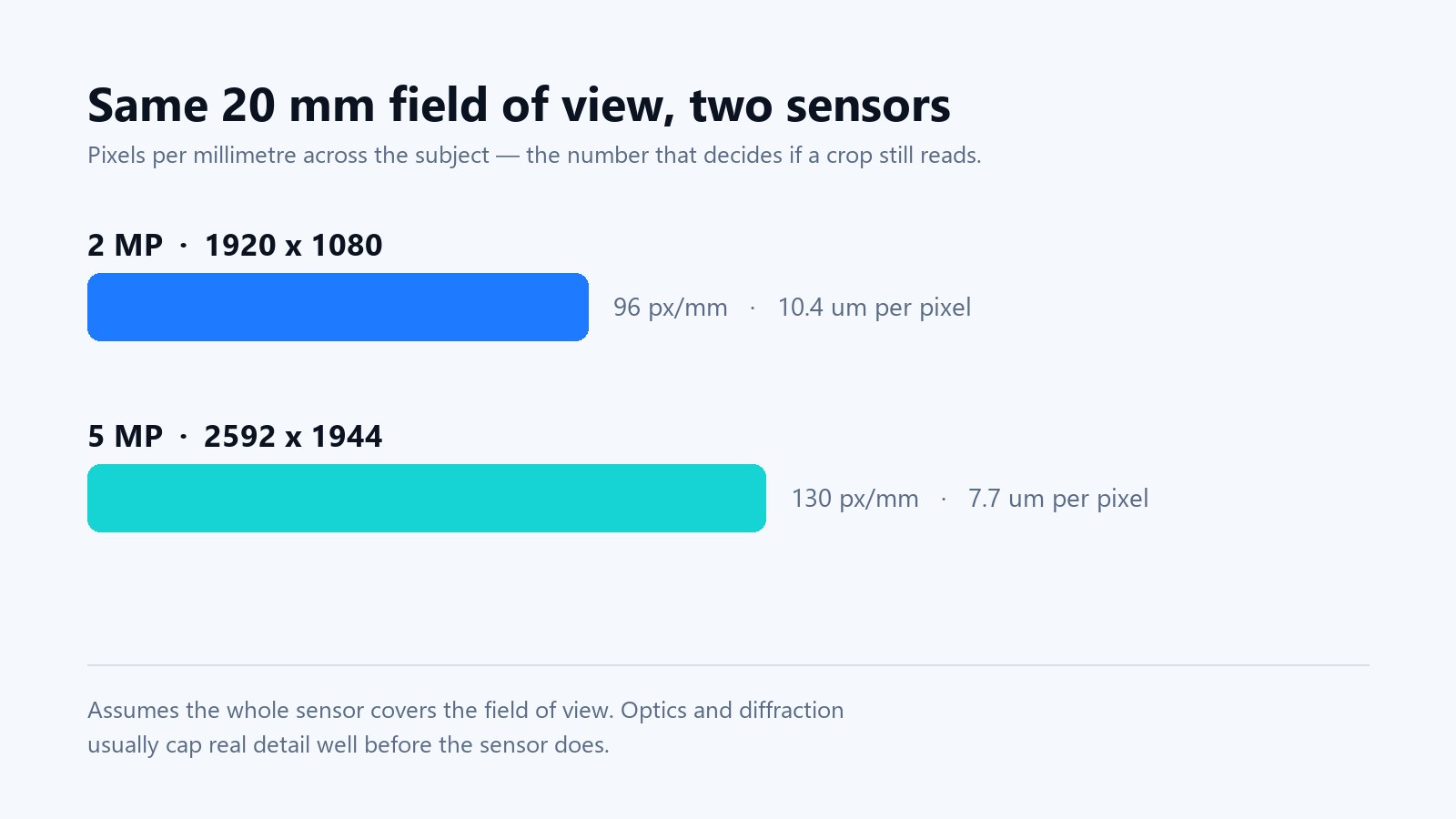
To judge a feature reliably you want at least three pixels across it. At that 20 mm field, 2MP supports features down to roughly 0.03 mm and 5MP down to about 0.02 mm. For context: solder bridging, silk-screen text and most component verification sit comfortably above both numbers. You are not sensor-limited here — the optics are the ceiling, and they usually are long before the sensor is.
A 5MP sensor behind a mediocre lens produces beautifully sharp photographs of blur. Real detail is limited first by the optics and the lighting, and only then by pixel count. Two questions cut through any listing: is the resolution figure the sensor's true native pixels (not interpolated), and is the magnification optical or digital zoom? We covered the same trap with magnification numbers in our PCB inspection buyer's guide.
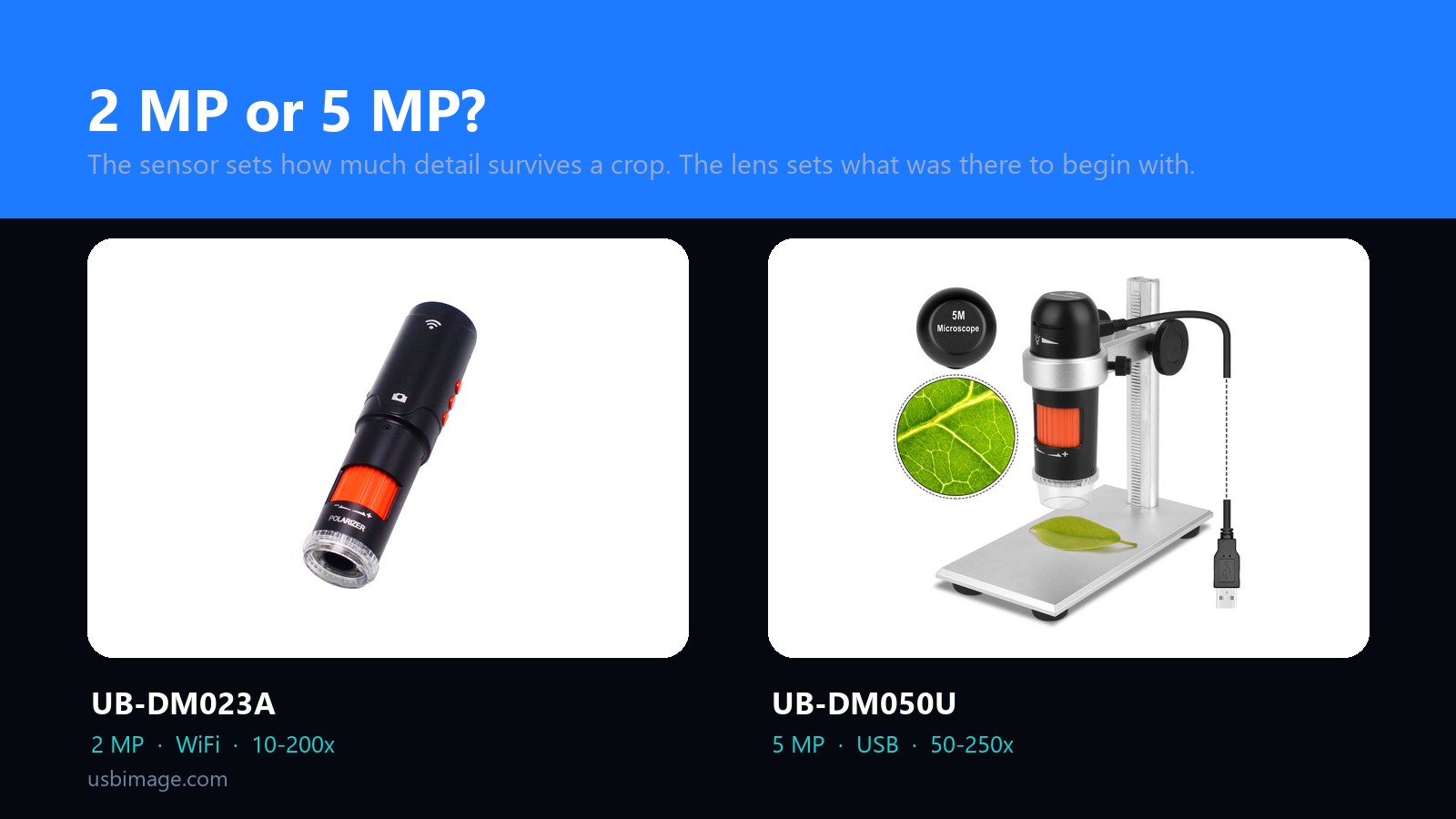
Choose 2MP for live inspection, video, wireless use and fleets. Choose 5MP for documentation, measurement, wide fields and crop-after-capture workflows. Running both worlds — bench plus field service? Standardise on the optics, not the sensor: many customers deploy the 5MP UB-DM050U at QC benches and the 2MP UB-DM023A in the field, with matching software.
Our UB-DM050U is the 5MP bench unit: 50–250× on an aluminium stand, built for documentation-grade captures. The UB-DM023A is the 2MP handheld: 10–200×, WiFi to phones and tablets, switchable polariser — read why that matters in our polarisation guide. Both run the same PC suite, and both can be white-labelled with your brand.
If you are spec'ing scopes for a product line rather than a desk, our OEM/ODM briefing guide covers how to start that conversation — or just tell us your inspection problem and we will recommend a sensor class, not a catalogue.
No. 5MP adds about 35% more detail per image edge, and only pays off when captures are wide, cropped or printed. For live solder-joint inspection at working magnification, a good lens on a 2MP sensor outperforms a poor lens on 5MP every time.
Usually, yes at full resolution. Most 5MP units run 1080p at 25–30 fps for live view and reserve full-resolution stills for capture mode; a full 5MP stream commonly drops to around 15 fps. That is why we quote 1080p video performance separately from still resolution.
No. Interpolated "12MP" listings enlarge pixels; they do not add information. Judge a camera by its native sensor resolution and whether the magnification figure is optical or computed.
Marking readability is dominated by optics and lighting, not sensor count. At a typical marking size of 0.3–0.5 mm, both sensor classes provide ample pixel density at moderate magnification; diffuse, glare-free illumination does more for legibility than megapixels.
Standardise on optics and software instead. A common pattern is 5MP at fixed QC benches where documentation matters and 2MP handhelds in the field, sharing the same measurement suite and report format. We can align both under one OEM software build.
Stand rigidity, lighting geometry and working distance decide whether an inspection scope is usable — sensor count rarely does.
Read the article →Crossed polarisers kill glare from solder mask, polished metal and wet skin. They also cost light — here is where the trade is worth it.
Read the article →