Digital Microscopes · Diagnostic Imaging · Custom Software
Sourcing

OEM/ODM microscope pricing for small batches: what actually drives the quote

Ask five factories to price the same 200 units and you will get five numbers that differ by more than the products do. That is not market opacity. A per-unit price is not a property of the microscope — it is the sum of two different bills, divided by a quantity you choose. Once you can see the split, the quotes stop being mysterious and start being comparable.
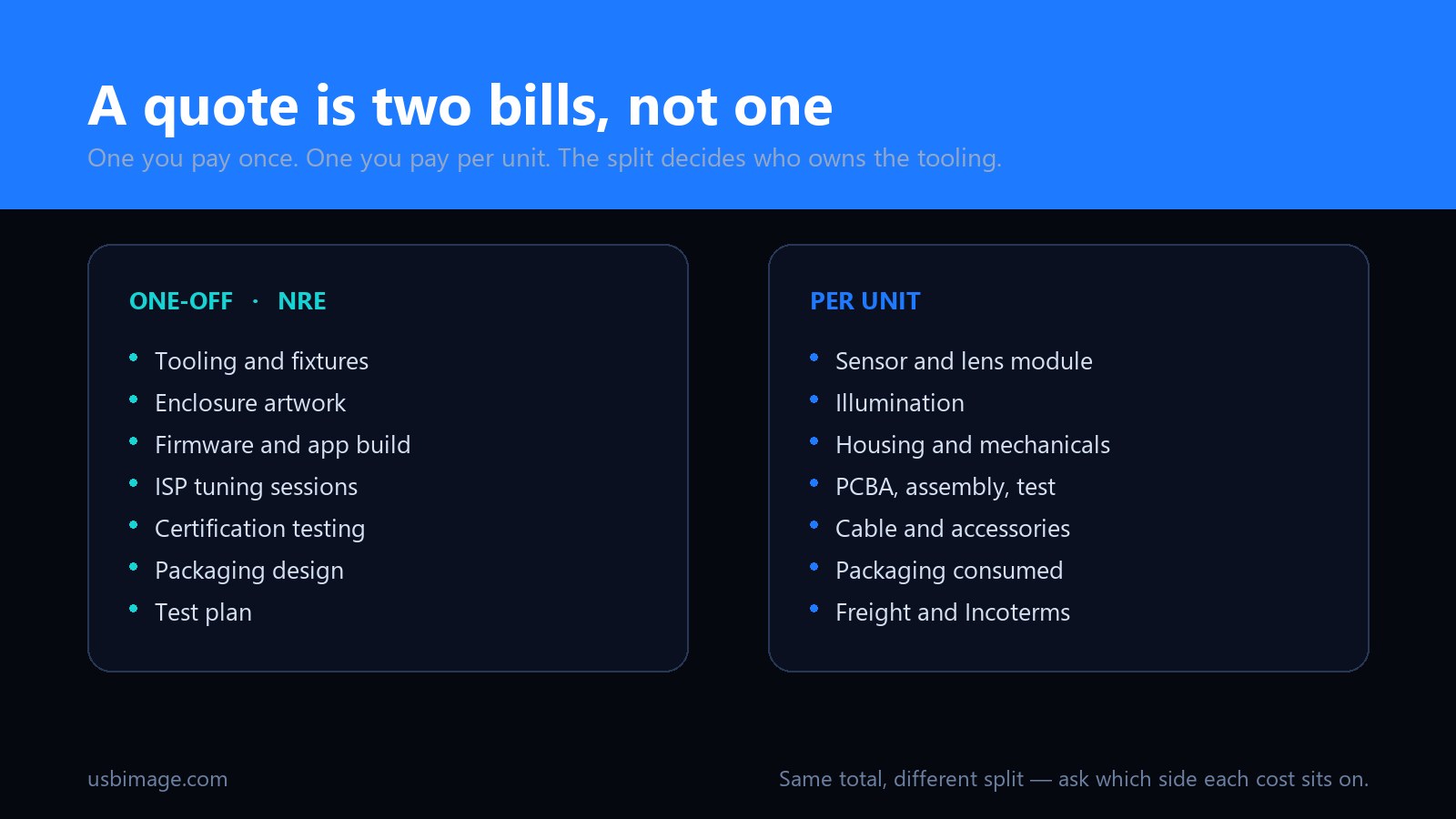
Diagram splitting an OEM microscope quote into a one-off engineering bill and a per-unit production bill, with the cost items that belong on each side
The same total can be built from very different splits — and the split decides who owns the tooling.

Every quote is two bills in one

The first bill is non-recurring engineering (NRE): costs you pay once, whatever the volume. The second is per-unit cost: what it takes to make and ship one more microscope. Suppliers rarely label them, so the single number you receive hides a decision about which costs sit where.

Typically one-off: tooling and fixtures, enclosure artwork and print plates, firmware and app customisation, ISP tuning sessions, certification testing, packaging design, and the test plan written around your configuration.

Typically per unit: sensor and lens module, illumination, housing and mechanical parts, PCBA, assembly and test labour, cable and accessories that go in the box, packaging consumed, and freight.

This is why a low unit price is not automatically a better price. If the NRE was folded into the unit number, you are prepaying engineering across your first order — and if you never order again, you paid the whole bill for a fraction of the work.

What is actually inside a unit price

When a buyer says "the other factory is cheaper", the difference is almost always on one of these lines rather than in the margin:

  • Sensor and optics. The biggest single lever. Sensor class, lens element count and coatings set both image quality and cost — and they are the first thing quietly downgraded to hit a target price.
  • Illumination. White, polarised, UV or IR means different LEDs, drivers and diffusers. A "polarised version" is not the same product with a filter added.
  • Housing and tooling. A moulded enclosure spreads its tooling across units; a machined one trades tooling for per-unit machining time. Two paths, two cost shapes.
  • Assembly and test time. Test minutes are real labour. A quote that assumes a 30-second functional check and one that runs a full optical alignment are not comparable, even at the same price.
  • Accessories. Stand, cable, calibration target, carry case. Buyers compare unit prices and then discover the other quote's box was emptier.
  • Compliance and freight. Marking and documentation are per configuration; Incoterms decide whether freight and duty are in the number at all.

Why small batches cost more per unit — and where the curve flattens

Four forces push the per-unit price up as volume falls, and none of them are anyone being punished for ordering small:
  • Component minimums. Sensors, connectors and LEDs are sold in reels and trays. Order below the pack quantity and you buy the pack anyway.
  • Tooling amortisation. A mould is cut once. Spread it across 2,000 units and it is a few percent; across 200 and it is a visible line.
  • Setup and changeover. Line time is consumed per production run, not per unit. A short run carries the same setup over fewer pieces.
  • Certification per configuration. Test reports attach to a build, not to a quantity. A small batch can carry the same compliance cost as a large one.
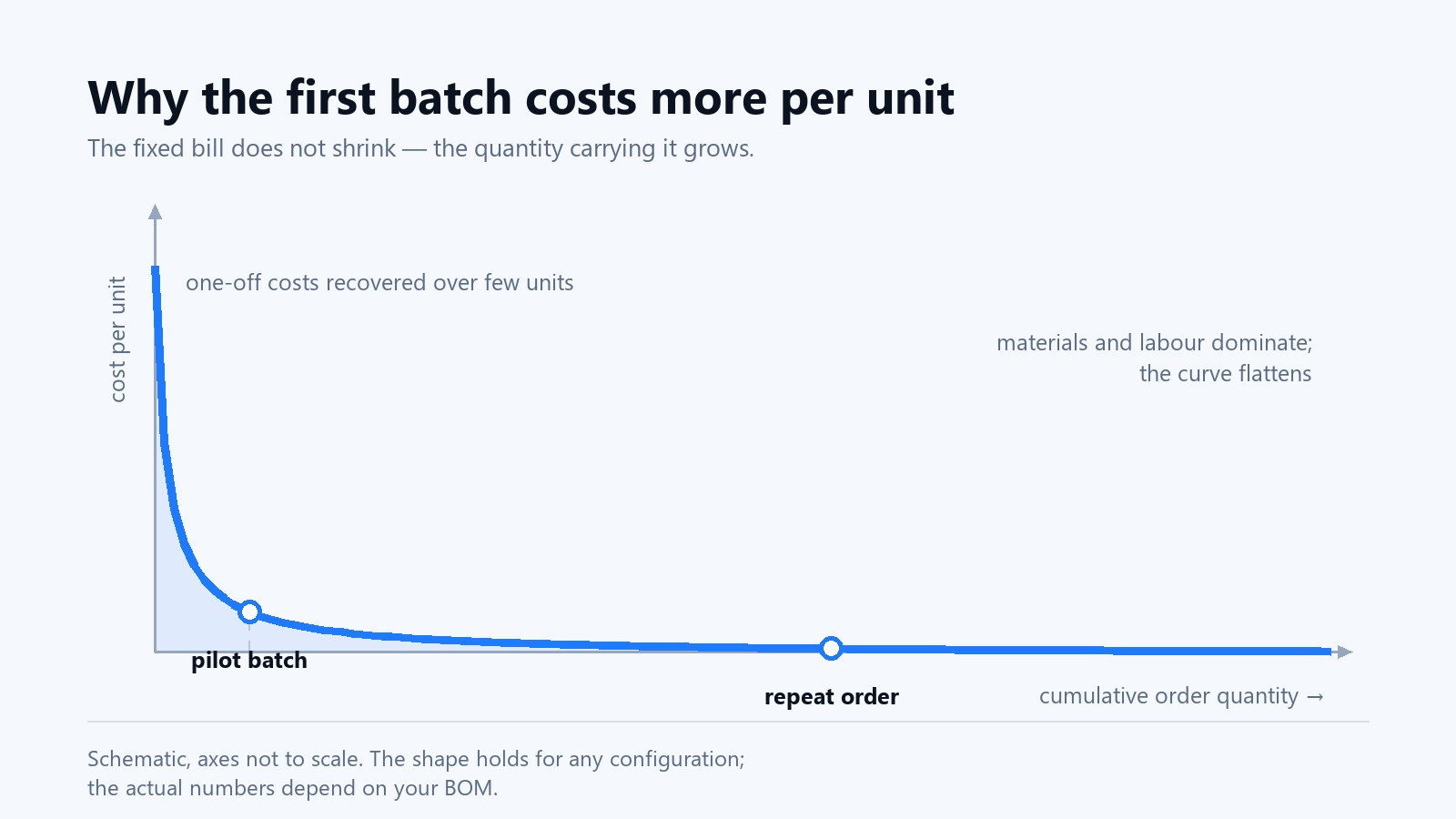
Schematic curve showing per-unit cost falling steeply as order quantity rises and then flattening, with the first batch dominated by one-off cost recovery
Schematic, axes not to scale: the shape holds for every configuration, the actual numbers depend on your BOM.

The practical consequence: treat the gap between your pilot price and your repeat price as tuition, not as a discount you are owed. A pilot batch buys tooling, tuning and a validated build — assets that make the second order cheaper. Buyers who negotiate the pilot down to the repeat price usually discover the difference reappears as a setup charge, a shorter warranty, or a supplier who declines the second order.

There is a reverse warning too: a factory quoting the same unit price at 200 and at 2,000 has either hidden the NRE, plans to renegotiate later, or has not costed the changeover at all.

"Should we go OEM or ODM?" is the wrong first question

The real question is what you are buying with the NRE: identity, or difference. Both are legitimate; they cost differently and they defend differently.

  • Rebrand on an existing platform (OEM). Lowest one-off cost, shortest lead time. You get your logo, packaging, splash screen and default settings. Your differentiation is distribution and service, not the device.
  • Variant of an existing platform (ODM). Moderate one-off cost: enclosure changes, colourways, firmware defaults, an extra illumination mode, a different lens. You get a product that looks and behaves like yours, on engineering that already exists.
  • New platform. Highest one-off cost and the longest timeline, because optics, mechanics, electronics and software all move together. This is the only route to a genuinely new capability — and the only one where IP ownership must be settled in writing before work starts.

The failure mode to avoid

Expecting ODM outcomes on an OEM budget. It is the most common way a small-batch project dies: the brief asks for a new enclosure, custom software and a modified optical path, the quote comes back at platform-rebrand money, and six weeks later the project is re-scoped. Decide how much difference your market actually pays for before the first call — our OEM/ODM briefing guide walks through that decision.

Six costs first-time buyers do not see coming

  1. ISP tuning re-opens on every sensor or lens change. Image tuning is not an edit; a new module means a new tuning session against new noise, colour and shading behaviour.
  2. Re-certification when the build changes. Swap the WiFi module or the sensor and an existing CE or FCC report may no longer cover the product.
  3. Packaging minimums. Printed cartons and inserts carry their own minimum print run, frequently larger than the order they are meant to wrap.
  4. Incoterms and duty. The same product quoted FOB and DDP differs by freight, insurance and import duty — a number that has nothing to do with the factory's efficiency.
  5. Spares and dead-on-arrival allowance. Budget a small stock of replacement units. It is cheaper than air-freighting one microscope to a customer who is already unhappy.
  6. Software maintenance. An app is not a one-time deliverable. Android and iOS release annually, and an unmaintained build stops installing long before the hardware wears out.

How to compare two quotes without being fooled

Normalise first, then compare. Nine lines decide whether two numbers mean the same thing:

  • Same Incoterm, same destination port
  • NRE shown as its own line, not buried in the unit price
  • Identical certification scope
  • Identical box contents — stand, cable, target, case
  • Sample cost and sample lead time stated
  • Payment terms and deposit percentage
  • Warranty length and dead-on-arrival policy
  • Tooling ownership written into the quote
  • Software ownership or licence terms written into the quote

A quote that lands materially lower is almost always different on one of these lines. Ask which one before you ask for a discount.

What makes a price come back firm instead of a range

Suppliers quote ranges when a variable is missing. Five inputs close most of the gap: volume (pilot and annual, separately), target market and certifications, the customisation list, software scope (who builds the app, who owns it), and your date. Tell us what you will not change, too — stability is worth money, because it removes re-work.

How we quote small batches

We show the split, because hiding it costs both sides time later:

  • NRE on its own line, itemised by activity, so you can see what you pay once.
  • Pilot and repeat quantities quoted side by side, so the cost curve is visible before you commit.
  • Tooling ownership stated in the quote — if you paid for it, you own it.
  • Software scope itemised: Android APK, iOS, Windows, macOS, web, SDK, and what maintenance means after handover.
  • No price list on this website. A published number would have to assume a configuration, a volume and a certification market — and would be wrong for almost everyone reading it.

If you are still choosing between a rebrand and a variant, the briefing guide is the better starting point. If you already know what you want to build, send the five inputs and we will quote the split — on a real configuration, not a catalogue position.

Frequently asked questions

Why does the same microscope cost more per unit in a small batch?

Because four fixed-cost forces are spread over fewer units: component pack minimums, tooling amortisation, production setup time, and certification that attaches to a configuration rather than a quantity. The unit itself did not change; the number of units carrying the fixed bill did.

Is there a minimum order quantity?

There is no single figure — it falls out of the configuration. Component pack sizes and tooling set a practical floor, and software customisation sets a different one. We quote a pilot quantity and a repeat quantity together so you can see what the floor actually costs before committing.

Can I avoid paying NRE by accepting a higher unit price?

You can ask for it amortised into the unit price, and some suppliers will do that. The risk is that you prepay engineering across the first order without owning the tooling or designs. Ask for the split anyway — even if you choose the bundled number, you should know what you are buying.

Should my first batch be OEM or ODM?

If the first batch exists to test whether the market wants the product at all, rebrand an existing platform and keep the one-off cost low. If your differentiation is the device itself — ergonomics, illumination, software workflow — budget for a variant. Buying ODM outcomes on an OEM budget is the classic way these projects stall.

Do certifications cost per unit or per model?

Per configuration, plus maintenance. Reports attach to a tested build: change the radio module or the sensor and an existing report may no longer cover the product, which means re-testing. That is why certification belongs on the one-off side of the quote, and why late BOM changes are expensive.

Read next

Keep going

OEM vs ODM: How to Brief a Microscope Manufacturer

What to specify, what to leave to the factory, and the details that decide whether a custom build ships on schedule.

Read the article →

2MP vs 5MP Microscope: Which Resolution Do You Need?

What the extra megapixels actually buy you, where they stop paying, and how optics and lighting quietly outrank both.

Read the article →